Please consider donating to Little Paths, Mwanza, Tanzania, one of our Club projects below:
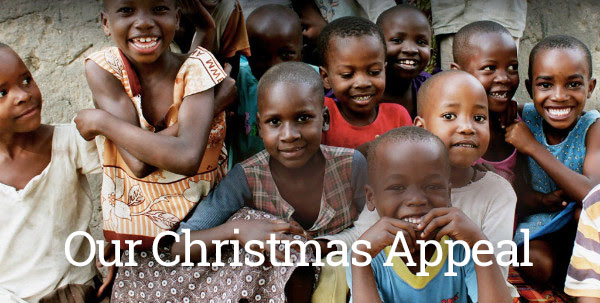
This Christmas period, we are aiming to raise $10,000 to help us to keep kids in school, off the streets and safely cared for by their families, in Tanzania. We simply insist and we hope you will too – that no child should ever leave their family looking for the opportunity to survive extreme poverty, this Christmas or any other.
Help us fight poverty by contributing a gift towards educational scholarships and family supports.
Raising $10,000 this Christmas period, will help us to continue our fight for safety, family and educated futures, to improve vulnerable lives.
Our next meeting will be a social meeting on Wednesday 20th December at 7.30pm Eastern Daylight Saving Time. Also we will induct a new member – Monica Vaughan and announce another award.
I found the article below on how to use social media more effectively. Applying some of these principles could assist our Club as we utilize this medium more to get our message out to the public.
It provides some useful information to help you to create and publish your social media to better effect.
Thanks to all who attended last week’s meeting. It was well attended and it was great to have Rotarian Steve Marlor from the Rotary Club of Drummoyne in Sydney, NSW join us for the meeting.
Our next meeting will be a social meeting on Wednesday 20th December at 7.00pm Eastern Daylight Saving Time. Also we will induct a new member – Monica Vaughan.
You may not be aware but I am a member of the Rotarian Action Group Against Slavery (RAGAS). All Rotarians are welcome to join. This is topical because the Australian Government is soon to introduce new legislation to target modern slavery in Australia. The article below explains some of our goals.
Education breaks the cycle of modern slavery
By Nikki Kallio
While many people would like to think that slavery was a tragedy of the past, the truth is that it still exists today, with up to 46 million people enslaved worldwide.
“It’s this Rotarian attitude – you give them a problem and instead of throwing their hands up in dismay, they start chipping away at it piece by piece,” says Carol Hart Metzker, a member of the action group. “Maybe slavery won’t be solved in my lifetime, but in two more years, we’re going to have a whole hamlet free.”
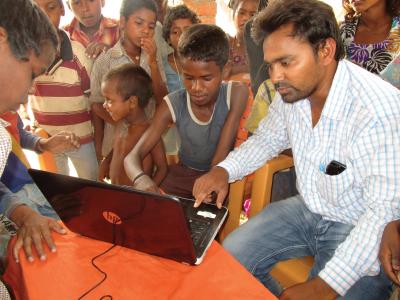
The students learn to use a computer, which is also used to document the project.
Voices4Freedom/Schools4Freedom
In a village in northeastern India, the action group is tackling the problem of debt bondage. With the help of 13 clubs, a district grant through the Rotary Club of Binghamton, New York, USA, and other sources, the action group is providing $36,000 toward the work of Schools4Freedom, a project of the organization Voices4Freedom. Schools4Freedom works with local partner organization Manav Sansadhan Evam Mahila Vikas Sansthan (MSEMVS) to battle debt bondage.
The RAGAS project will support the efforts in one of those villages for three years. The name of the village, which is in the Uttar Pradesh state, is kept secret to protect the villagers and aid workers.
Poverty, illiteracy, innumeracy, and natural disasters that destroy crops or homes can leave villagers vulnerable to debt bondage in rural villages.
“When people don’t have enough to eat, and they barely have the ability to keep a roof over their head and their family quite literally alive, they will often turn to whatever means are possible for survival,” Metzker says.
Families may seek an arrangement with a business owner, who asks them to sign a contract that they can’t read and therefore can’t understand, and they inadvertently trade their freedom for survival, she says.
“The slaveholder creates a scheme such that the interest is more than the family ever makes, so no money really changes hands, and the family gets further and further into debt,” Metzker says. “That contract is never paid off.”
The slaveholder creates a scheme such that the interest is more than the family ever makes, so no money really changes hands, and the family gets further and further into debt. That contract is never paid off.
Carol Hart Metzker
Rotarian Action Group Against Slavery
Of the village’s 400 residents, 132 are living in debt bondage, enslaved in the slaveholder’s brick kilns, farm, or construction projects, she says. “The others are at risk because they, too, are in abject poverty.”
Hundreds of thousands of people in Uttar Pradesh and the neighboring state of Bihar are working in forced labor in industries including agriculture, domestic servitude, commercial sex, stone quarries, or brick kilns, says Bhanuja Sharan Lal, director of MSEMVS.
The problem is exacerbated by inaction on anti-slavery laws, caste discrimination, discrimination and violence against women, lack of effective protection for children, lack of training of front-line officials, and corruption, Lal says.
“Businesses and landlords, mostly in the informal sector, face no effective sanctions for holding and using people in forced labor,” he says. “The status quo survives because in many industries the business model relies on debt bondage as a means to control workers.”
The Schools4Freedom project establishes a school, including funding for two teachers. Children receive school supplies and three years of hot lunches. The village gets a computer to document the project. A solar light is installed in the village to help protect children from snakebites and help prevent sexual assault against women. Women are trained in a trade.
“What’s so amazing about Schools4Freedom is that one removes all of these vulnerabilities,” Metzker says. “You strengthen the people and then you teach them that they have basic rights so that they can go and, in a sense, demand that freedom themselves.”
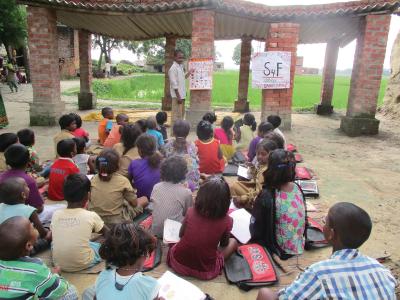
Funds also pay for a simple school structure of brick pillars with a corrugated tin roof. It keeps the extreme heat and rain at bay, “but it’s not such an amazing building that someone can take it over,” she says. “It’s not so valuable that a slaveholder would burn it down to stop the process.”
Most important, the project pays for two front-line workers who are local and highly specialized in educating the villagers. The workers teach them that they have basic human rights such as freedom and access to government services – and all of this is done quietly at first, Metzker says.
Students learn the alphabet in the open-air school structure.
“You have to know how to do it, when to do it, the safe way to do it so that the front-line workers themselves and the villagers don’t take the brunt of a slaveholder’s anger,” she says. “We can’t, as Rotarians, do that job.”
The school structure is usually the first sign to the slaveholders that something may be happening, and they may ridicule the children for getting an education, trying to convince them that it’s pointless.
“Does the slaveholder think about where that’s going in two or three years? The writing is on the wall,” Metzker says.
Sometimes slaveholders, not wanting to lose the labor, will create employment arrangements with the villagers. Other times, slaveholders become violent and the situation requires legal action, she says.
The three-year process ensures time for the entire village to see that it is in a position of strength.
Additionally, liberated villages are connected to a network of other freed villages, to continue supporting one another, says Peggy Callahan, co-founder of Voices4Freedom.
The problem of debt bondage is insidious because it can entrap multiple generations. But with the project efforts, “not only will these people be free and educated and able to build a life of dignity, but their children and grandchildren and great-grandchildren will be born in freedom,” Callahan says.
Metzker, who is a member of the Rotary E-Club of One World D5240, became involved in anti-slavery efforts after a National Immunization Day trip to India in 2004, during which she visited a center for children who had been freed from slavery. She went on to write the book Facing the Monster: How One Person Can Fight Child Slavery and now works as a consultant to the Salvation Army’s New Day to Stop Trafficking program. She received Rotary’s Service Above Self Award in 2009-10.
“Someday, there is going to be such a huge difference because we realized there really is something you can do,” she says. “And we did it.”
This is another Rotary Action Group that does great work.
Cleaning up the rivers of the world
By the Water & Sanitation Rotarian Action Group (WASRAG)
Today, 1.8 billion people use a source of drinking water contaminated with feces, putting them at risk of contracting cholera, dysentery, typhoid and polio. In 1993, the United Nations General Assembly officially designated 22 March as World Water Day. This annual day is coordinated by UN-Water in collaboration with governments and partners to tackle the water crisis.
The United Nations Sustainable Development Goals, launched in 2015, include a target to ensure everyone has access to safe water by 2030, making water a key issue in the fight to eradicate extreme poverty.
In celebration of World Water Day 2018, the Water & Sanitation Rotarian Action Group (WASRAG) is encouraging Rotary clubs throughout the world to consider adopting a river clean-up or similar project in or near their community. Since the time of year to best implement these types of projects varies from region to region, your project can take place at any time leading up to World Water Day, but we will celebrate and promote your projects as part of World Water Day activities.
Don’t know where to start? Contact your local conservation authority (if there is one) and they can point you to areas in your community where the need is most critical and alert you to environmentally sensitive issues. Here are a few types of hands on projects your club can take on:
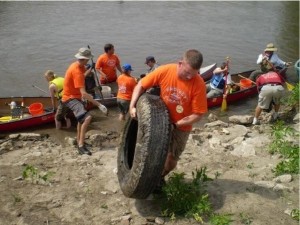
Cleaning up debris along a river or stream, and recycling qualified items
Planting trees and native plants along the water
Promoting safe and organic alternatives for lawn and garden fertilizers
Creating awareness about invasive water species
Partnering with local conservation and water protection NGOs on projects
Encouraging slow speeds of boats and other water toys
Planting a rain garden
Creating awareness about not dumping into storm drains
Promoting use of non-toxic tackle for fishing
We also encourage you to educate your community on river clean-up projects and promote the benefits through programs such as:
Hosting an essay contests on why rivers need to be kept clean
Educating others on social and digital media
Organizing club programs about the benefits of clean water
Hosting friendly club project competitions
Participating in community events to promote Rotary’s involvement in World Water Day: Chamber of Commerce activities, local conservation events, etc.
Enter in our competition for a chance to win!
Submit a brief description of your project, including what you’ve done, the target audience and the expected impact. Remember to tell us your district number and club name as well as your name, email address and phone number. Please send all entries to info@wasrag.org.
DEADLINE: May 1st, 2018
AWARDS: Two outstanding projects (the most impactful and the most innovative) will be selected for a USD $500 award. Winners will be notified by May 31st, 2018. The awards will be presented at WASRAG’s Annual General Meeting on Saturday June 23rd, 2018 in Toronto, Canada.
We encourage you to promote your project during club meetings leading up to World Water Day and be sure to add them to Rotary Showcase. WASRAG will also promote select projects in our newsletter, website, and on social media. Take action and join our World Water Day Challenge!
During November a number of members have donated to The Rotary Foundation (TRF). Thank you to those members and I encourage all who haven’t given yet to consider doing so. Our Treasurer will forward the donations to TRF, early in the new year so you still have time to make your donations.
You will find details of how to make your donation below.
EFT Payments please make out to:
Account Name: The Rotary E-Club of District 9700 – Service/Projects, Reference – Name plus ‘TRF’ BSB: 032769 Account: 697413
Cheque Payments by post make out to: Rotary E-Club of District 9700-Serving Humanity
Reference – ‘TRF and your name’, and mail to:
Treasurer, Rotary E-Club of District 9700-Serving Humanity, 32 High St (PO Box 25), YACKANDANDAH, VIC 3749
The article below explains some of the areas that our Foundation supports with your donation.
GIVE THE GIFT OF ROTARY
For more than 100 years, The Rotary Foundation has been supporting Rotarians’ work to create sustainable solutions to our world’s most pressing needs. But there is still much to do, and we need your help.
Rotary gives in countless ways, focusing our service efforts in six areas: promoting peace, fighting disease, providing clean water, saving mothers and children, supporting education, and growing local economies. We’re also working hard to end polio once and for all.
Give the gift of Rotary today and be a part of the positive change Rotarians are making in your community and around the world. Every gift makes a difference.
What your gift supports
$10 mosquito bed net
Bed nets provide a safe, peaceful night’s rest in countries like Uganda, where malaria is a major health concern.
$15 polio vaccines
Polio is still a crippling threat to children in Afghanistan, Nigeria, and Pakistan. A gift of just $15 can protect children for life.
$50 water filter
In rural Guatemala, deadly waterborne diseases are common. Personal water filters fill the need for clean water.
$85 business classes
In the United States, business classes teach low-income entrepreneurs the skills they need to be successful.
$100 sewing machine
With a sewing machine, a microloan, and some training from Rotary, entrepreneurs can turn their sewing skills into a thriving business.
$200 medical equipment
Newborns start their lives healthy when hospitals have up-to-date equipment to care for babies in the first moments of their lives.
$500 anti-bullying campaign
No child should live in fear of being bullied. Your gift helps communities create a safe and positive atmosphere where children can thrive.
$1,000 conflict resolution training
When secondary school students learn to resolve conflict, they can build a more peaceful and secure future for themselves and their communities.
$2,650 irrigation system
In areas where food security is a concern, irrigation systems give farmers a reliable and efficient water source so they can grow crops and provide food for the community.
Your gift supports projects like those described here but may not purchase the specific items listed.
Promote the Give the Gift of Rotary campaign by linking to this page on your website and social media pages. You can also distribute our promotional flier at club meetings and community events.
Athili Sapriina during the annual Rotary Peace Fellow seminar at the University of Queensland, Australia.
By Athili Sapriina, 2013-2014 Rotary Peace Fellow at the University of Queensland, Australia
I first became aware of Rotary Peace Fellowships during a trip to the Rotary Peace Center at Duke University and the University of North Carolina at Chapel Hill, US, in 2008. I had previously attended the United Nations Permanent Forum on Indigenous Issues in New York City and over the years witnessed an increased involvement of Rotary with indigenous peoples issues. I am honored to be the first Naga to be awarded a Rotary Peace Fellowship.
The three million Nagas are indigenous peoples of the mountainous frontier between India and Burma. Since the end of British colonialism, Nagas have fiercely defended their independence resulting in the death of thousands — Indians, Burmese and Nagas.
The peace fellowship gives me a chance to build on current peace initiatives to resolve one of the longest running disputes in the world. Nagas seek the reunification of their homeland, which is divided between India and Burma. Within India, Nagas are further segregated into four states reducing them to minorities in their own land.
Working toward peace necessitates continuous dialogue. I find it fascinating that indigenous leaders, support groups, and national governments continue to engage on these issues even where agreement is lacking on how the UN declarations apply. For example, some states do not acknowledge they have indigenous peoples within their territories, and therefore do not recognize a responsibility under the declaration. Achieving peace, understanding, and justice is a work in progress.
Still, in September, the first World Conference on Indigenous Peoples is expected to reiterate the important and continuing role of the UN in promoting and protecting the rights of indigenous peoples.
As a print journalist, I plan to use my skills to work for peace, justice, and greater tolerance, while branching out into radio and current media platforms. My peace fellowship has increased my capacity to contribute meaningfully to this important issue.
International Day of the World’s Indigenous Peoples is 9 August. Watch a live webcast of the commemoration at the UN on 8 August and learn more about how you can support the Rotary Peace Centers program.
We will hold a Social Meeting of our Club this next Wednesday, 22nd November at 7.00pm Eastern Summer Daylight Time (NSW) or 6.00pm Eastern Standard Time (QLD). We will discuss our KIVA loans and our badges, brochure, business cards and banner.
Be prepared to tell us about you last couple of weeks and anything that inspired you.
If any non-member wishes to attend please contact me with your email address so that you get a link to our ZOOM meeting. – johnroberson@bigpond.com
Below is more about the Peace day in Geneva on 11th November.
‘Peace needs to be lived’
Rotary Day at the United Nations pushes peace from concept to reality
By Geoff Johnson Photos by Monika Lozinska
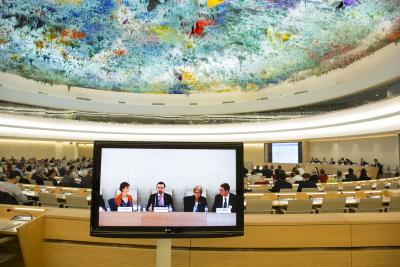
On the 99th anniversary of the end of World War I, more than 1,200 people gathered in Geneva, Switzerland, for Rotary Day at the United Nations.
Representing 87 countries, they convened on Saturday, 11 November, at the Palais des Nations, originally the home of the League of Nations, and dedicated themselves to the theme introduced by Rotary President Ian H. S. Riseley: “Peace: Making a Difference.”
View SlideshowRotary International honors six champions of peace at the United Nations on 11 November.
“The advancement of international understanding, goodwill, and peace have always been among Rotary’s primary goals,” said Riseley. “It is past time for all of us to recognize the potential of all of our Rotary service to build peace, and approach that service with peacebuilding in mind.”
For the first time in its 13-year history, Rotary Day at the UN was held outside of New York.
Rotary Day concluded Geneva Peace Week, during which John Hewko, general secretary of Rotary International, noted the “close and longstanding ties between Rotary and the UN in (their) mutual pursuit of peace and international understanding.”
Rotary members “can transform a concept like peace to a reality through service,” said Ed Futa, dean of the Rotary Representatives to the United Nations. “Peace needs to be lived rather than preached.”
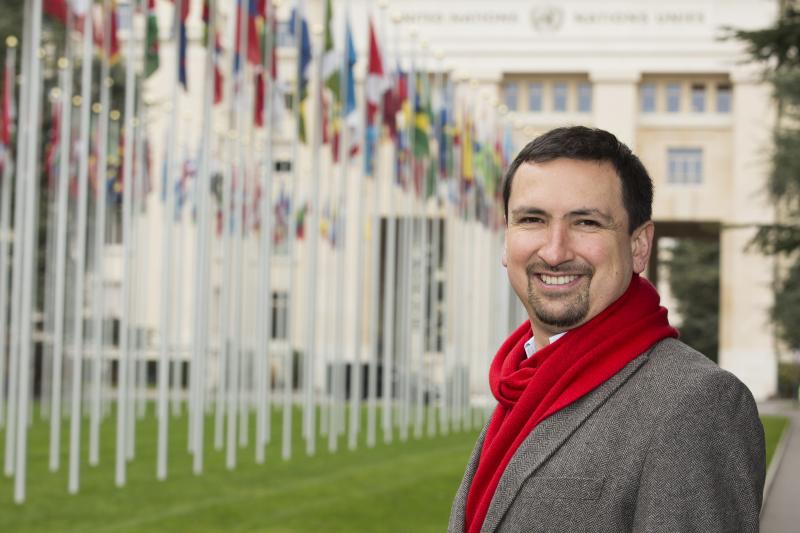
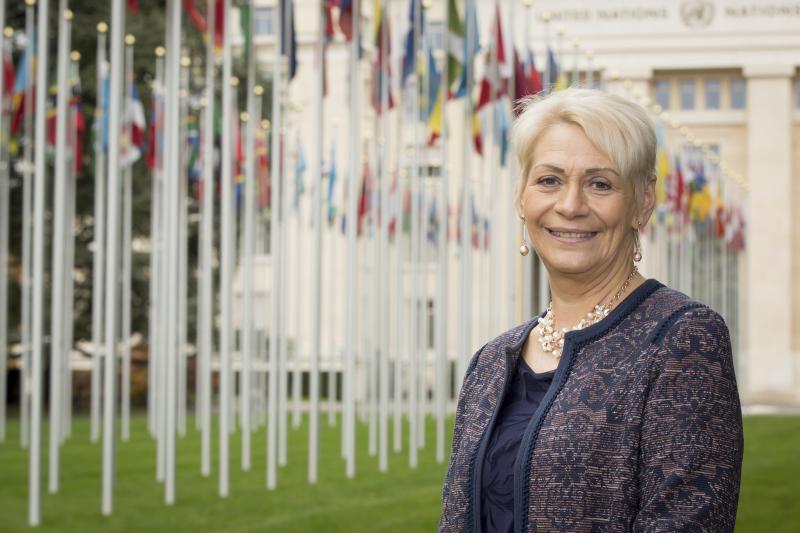
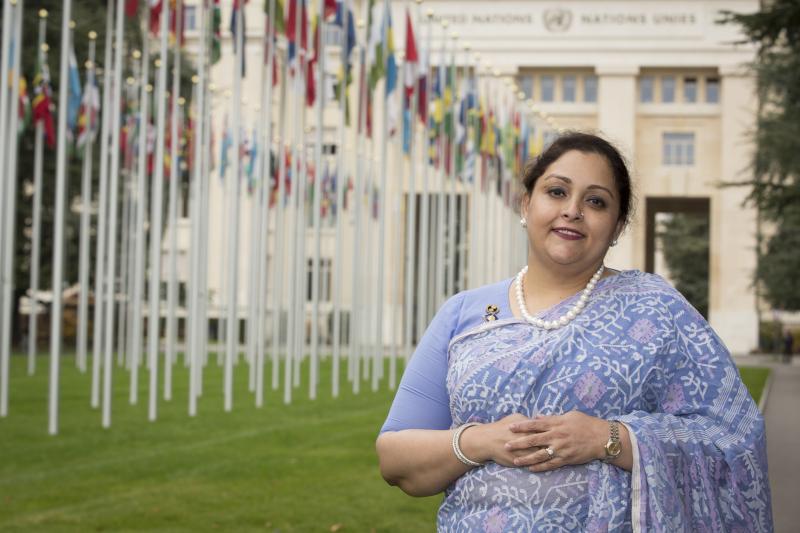
During a Rotary Day highlight, Hewko introduced Rotary’s 2017 People of Action: Champions of Peace. He praised them as “an embodiment of the range and impact of our organization’s work,” and saluted them for providing “a roadmap for what more peaceful, resilient societies look like.”
Rotary honored six individuals, who each made brief remarks. They were:
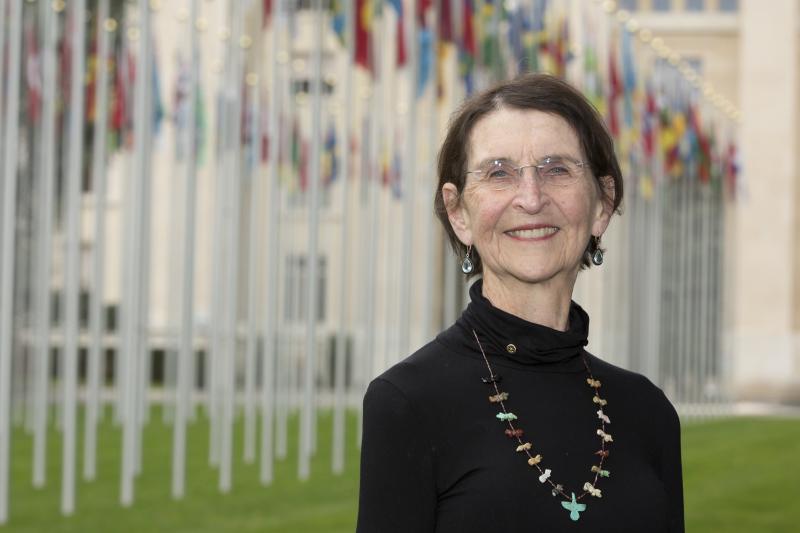
Alejandro Reyes Lozano, of the Rotary Club of Bogotá Capital, Cundinamarca, Colombia: As “part of the generation that grew up with uncertainty and fear,” as he put it, Reyes Lozano played a key role in negotiating an end to the 50-year conflict between the Colombian government and the Revolutionary Armed Forces of Colombia (FARC). Now he’s using a Rotary Foundation global grant to lead peacebuilding efforts among women from six Latin American countries.
Jean Best, of the Rotary Club of Kirkcudbright, Dumfries and Galloway, Scotland: “Without peace within ourselves we will never advance global peace,” said Best, explaining The Peace Project, the program she created to help “the future leaders of peace” develop the skills they need to resolve the conflicts in their lives.
Safina Rahman, of the Rotary Club of Dhaka Mahanagar, Bangladesh: “Education is a powerful and transformative vehicle for peace,” said Rahman, a passionate advocate for workers’ rights and workplace safety who also promotes and provides educational and vocational opportunities for girls.4.
Ann Frisch, of the Rotary Club of White Bear Lake, Minnesota, USA: Frisch’s Civilian-Based Peace Process introduced the radical concept of “unarmed civilian protection” in war zones around the world. “Sustainable peace,” she said, “requires strong civilian engagement.”
5.
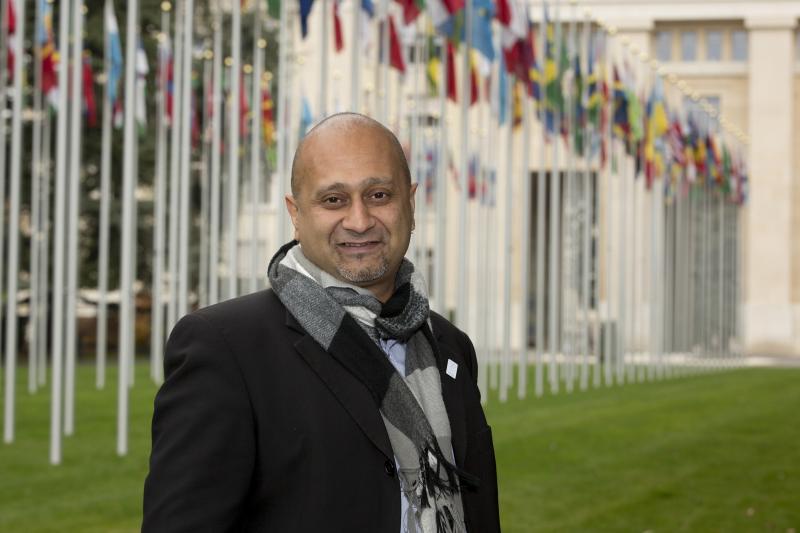
Kiran Singh Sirah, Rotary Peace Fellow: As the president of the International Storytelling Center in Jonesborough, Tennessee, USA, Sirah uses stories to foster peace, nurture empathy, and build a sense of community. “Stories matter—and I believe they matter a lot,” he said.
6.
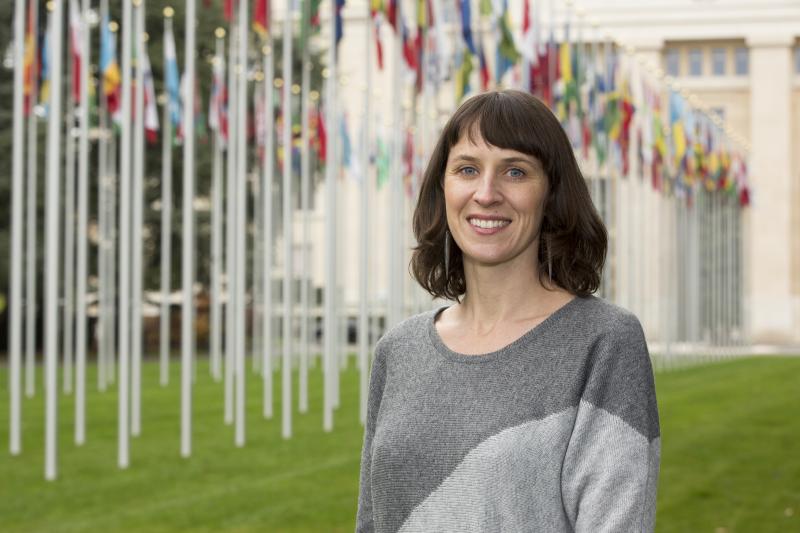
Taylor Cass Talbot, Rotary Peace Fellow: Currently based in Portland, Oregon, USA, Cass Talbot partnered with SWaCH, a waste-picker cooperative in India to form Pushing for Peace, which promotes safety, sanitation, and dignity for waste pickers in Pune, India. Her advocacy displays an artistic flair: her Live Debris project creatively addresses issues of waste on a global scale.Later, the six honorees participated in workshops devoted to sustainability and peace, as well as a workshop on education, science, and peace designed by and for young leaders in which Rotaract members from around the world played a prominent role.
Dr. Michel Zaffran, the director of polio eradication at the World Health Organization, provided an update on efforts to eradicate polio. They noted the tremendous progress made by Rotary, WHO, the Bill & Melinda Gates Foundation, and other partners in eliminating 99 percent of all global incidences of polio.
Returning the focus to peace, Zaffran said: “This same international relationship (that’s eradicating polio),” he said, “can be used to achieve world peace.”
Zaffran was joined Her Excellency Mitsuko Shino, the deputy permanent representative of Japan to the international organizations in Geneva and co-chair of Global Polio Eradication Initiative’s Polio Partners Group.
In his keynote address, Riseley made a similar observation. “The work of polio eradication, has taught us . . . that when you have enough people working together, when you understand the problems and the processes, when you combine and leverage your resources, when you set a plan and set your targets — you can indeed move mountains,” he said. “And the need for action, and cooperation, is greater now than ever before.”
Watch the opening session of Rotary UN Day including remarks by the 2017 People of Action: Champions of Peace.


 Today, 1.8 billion people use a source of drinking water contaminated with feces, putting them at risk of contracting cholera, dysentery, typhoid and polio. In 1993, the United Nations General Assembly officially designated 22 March as World Water Day. This annual day is coordinated by
  Submit a brief description of your project, including what you’ve done, the target audience and the expected impact. Remember to tell us your district number and club name as well as your name, email address and phone number. Please send all entries to