President’s Comment – 16 Apr 17

Board Meeting held Wednesday 12th April

Thank you to all who attended the meeting last Wednesday. If I had not mixed up the timings we would have had 8 attendees – so apologies for the mix up but we had a good role up anyway. As discussed at the meeting please read about KIVA and give some consideration to donating a small amount to an account that I have established in the name of Rotary E-Club of D9700, Australia. Contact me by email for details of how to login and make a donation.

We can discuss starting to lend the funds we accumulate at the next Board meeting.

KIVA

Kiva is an international nonprofit, founded in 2005 and based in San Francisco, with a mission to connect people through lending to alleviate poverty. We celebrate and support people looking to create a better future for themselves, their families and their communities.

Website – https://www.kiva.org/

By lending as little as $25 on Kiva, anyone can help a borrower start or grow a business, go to school, access clean energy or realize their potential. For some, it’s a matter of survival, for others it’s the fuel for a life-long ambition.

100% of every dollar you lend on Kiva goes to funding loans. Kiva covers costs primarily through optional donations, as well as through support from grants and sponsors.

Kiva by the numbers:

2.4Million Borrowers in 83 Countries.

1.6M Lenders who have loaned $967.2M Loans funded through Kiva at 97.0% Repayment rate

It’s a loan, not a donation

Kiva believes lending alongside thousands of others is one of the most powerful and sustainable ways to create economic and social good. Lending on Kiva creates a partnership of mutual dignity and makes it easy to touch more lives with the same dollar. Fund a loan, get repaid, fund another.

You choose where to make an impact

Whether you lend to friends in your community, or people halfway around the world (and for many, it’s both), Kiva creates the opportunity to play a special part in someone else’s story. At Kiva, loans aren’t just about money—they’re a way to create connection and relationships.

Pushing the boundaries of a loan

Kiva started as a pioneer in crowdfunding in 2005, and is constantly innovating to meet people’s diverse lending needs. Whether it’s reinventing microfinance with more flexible terms, supporting community-wide projects or lowering costs to borrowers, we are always testing and learning.

Lifting one, to lift many

When a Kiva loan enables someone to grow a business and create opportunity for themselves, it creates opportunities for others as well. That ripple effect can shape the future for a family or an entire community.


Due diligence and monitoring

Kiva takes due diligence and monitoring very seriously as part of our responsibility to lenders and borrowers. We encourage all lenders to learn about the risks of lending on Kiva as Kiva does not guarantee repayment on any loans. Lending on Kiva may involve loss of principal, for a variety of reasons including if the borrower doesn’t repay, the Field Partner doesn’t repay or from currency loss.

The level of due diligence relevant to a specific loan on Kiva depends on a variety of factors, including how the loan is administered. Most loans on Kiva are administered by one of our local partners working in more than 80 countries. Kiva conducts due diligence on all Field Partners prior to allowing them to begin posting loans on the Kiva platform. To learn more about this process visit our Field Partner due diligence page.

Almost all Kiva loans for borrowers in the U.S. are direct loans, which are not administered by a Field Partner. This gives Kiva the ability to reach populations that even microlenders can’t or don’t serve, but it also means these loans often involve a higher level of risk or default. To learn more about the due diligence for these U.S. loans, please visit the due diligence page for direct loans.


The risks of lending

Microloans reach populations that have limited access to financial services, so these types of loans come with some inherent risks for lenders. When you lend money on Kiva, you may lose some or all of your principal. You should be aware of the different types of risk (some of which are outlined below) and find the right loan option for you, with respect to repayment risk and social return.

Kiva’s current repayment rate is reflected below. The “overall repayment rate for all loans” includes all loans in all countries, including loans that were repaid or defaulted and loans that are currently paying back. It also factors in currency loss. Please note that past repayment performance does not guarantee future results. To review the terms that apply to your use of Kiva, please see our terms of use.

In order to help reduce your risk exposure, you may wish to diversify your Kiva portfolio, thus reducing your exposure to any one borrower, Field Partner or country. For example, instead of placing $100 with 1 borrower, you may wish to place $25 with 4 borrowers in different countries.

Repayment rate statistics

  • Repayment rate for all loans: 97.0%
  • Repayment rate for ended loans only: 98.0%
  • Repayment rate for partner facilitated loans: 97.2%
  • Repayment rate for direct U.S. loans: 83.3%
  • Borrower repayment rate for all loans: 97.5%
  • Currency exchange loss rate: 0.5%

President’s Comment – 9 Apr 17

8,000 kilometers to peace

Rotary members in a small town of Nova Scotia, Canada, took action to bring two families from war-torn Syria to their country, where the refugees are starting a new life.

By Ryan Hyland Produced by Andrew Chudzinski

Alchehade grabbed the children and ran into the night and the choking smoke and dust. A neighbor helped her carry her three-year-old twin boys, Mounzer and Kaiss; another drove the pickup truck they all clambered into. Over the next several days, as bombs continued to fall, the family – including daughters Kawthar, age six, and Roukia, a baby – took refuge in a nearby forest, sleeping under the trees as Sultanah tried to figure out their next move.

In neighboring Lebanon, Sultanah’s husband, Mazen, frantically tried to contact his wife. For years, Mazen had shuttled back and forth across the border every few weeks to do construction work on high-rise buildings in Beirut. While the jobs provided an income for his family, he says, the separation was hard. But their situation had just gotten much harder. 

With the Syrian civil war now engulfing his village, Mazen couldn’t return. And it would be four months before his wife and children could cross into Lebanon. 

Eventually, the family was reunited. They were alive. But they were refugees, seeking asylum in any country that would take them, hoping to get far away from the violence that had driven them, along with millions of other Syrians, into foreign lands.

The Alchehade family registered with the United Nations High Commissioner for Refugees  (UNHCR), the agency responsible for resettling Syrian refugees, and waited. They were still in Lebanon nearly three years later.

Meanwhile, 8,000 kilometers away, Rotarians in the small town of Amherst, Nova Scotia, were watching images of Syrian refugees on television and looking for ways to help.

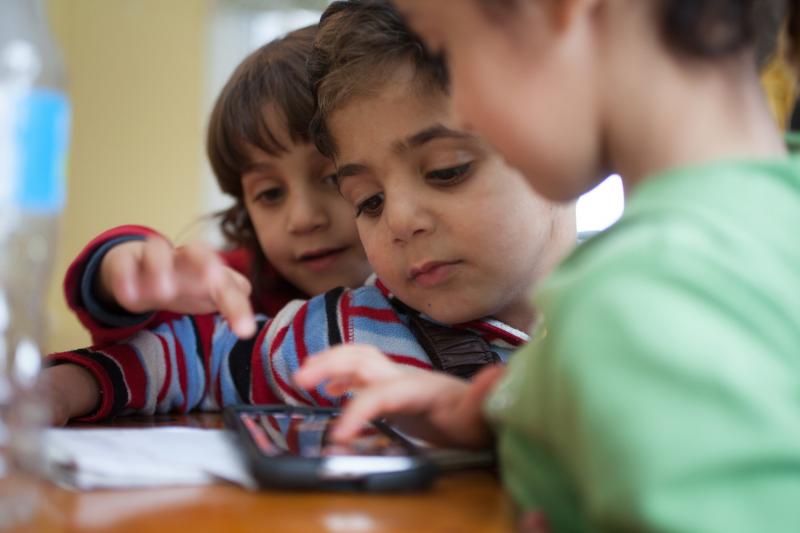
  1. The Alchehade children love singing the alphabet song, which they quickly learned from English tutors. 
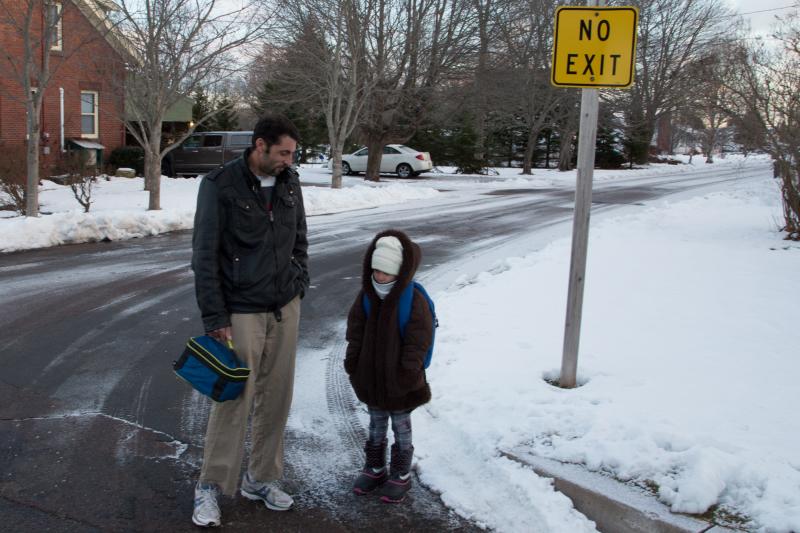
    Mazen Alchehade, who works for a landscaping company, walks his 6-year-old daughter, Kawthar, to her bus stop before school. 

     
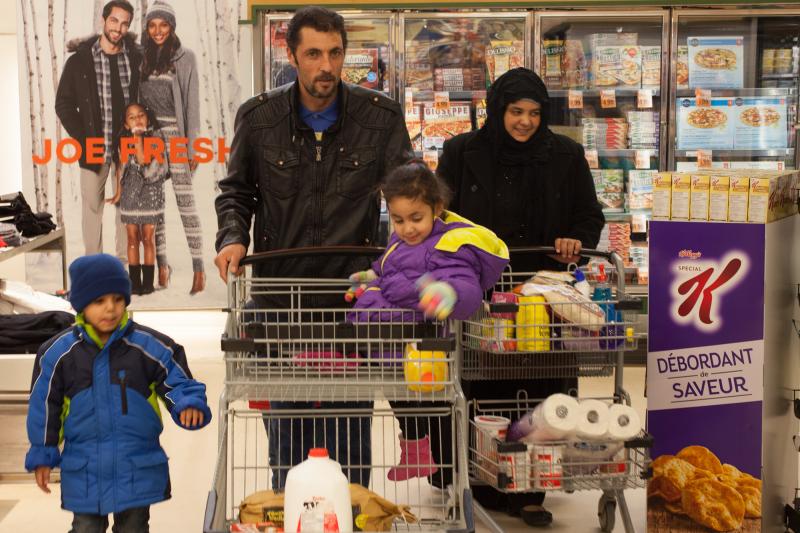
    Mazen and Sultanah Alchehade are building a new life for their children in Nova Scotia after being forced to flee their home during Syria’s violent civil war.  More than 11 million people have been displaced since the conflict began in 2011. 

    Sultanah Alchehade and her husband, Mazan, wanted to live in a smaller community like they did in Syria so they chose Amherst instead of Toronto or Montreal. 

    A new culture 

In September 2015, members of the Rotary Club of Amherst were thinking about their next international project. Over the years, the group has helped build and equip a school in South Africa, provided educational materials to students in the Bahamas, and raised funds for disaster-stricken areas around the world, but their thoughts turned to Syria as the plight of refugees dominated the news.

“We as Rotarians couldn’t ignore what we were watching each and every day,” says Ron Wilson, a semiretired civil engineer. “Families dying while making their journey to Europe or other places. Families desperately trying to flee war and, sadly, their homes. The heart-wrenching images were the impetus for our club to do something.”

Ann Sharpe had joined Rotary specifically to get involved with projects to help refugees. In May 2014, she had attended the wedding of some friends in Turkey, which has taken in nearly 3 million Syrian refugees since 2011, more than any other country. While in Istanbul, Sharpe saw refugee children on the streets begging for food or money. 


Why host a Rotary Peace Fellow?

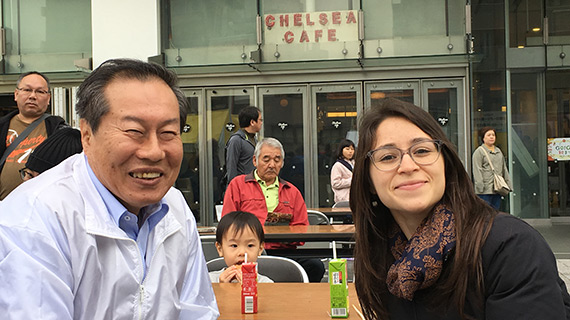
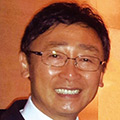
Masao Mizuno meets with a Rotary Peace Fellow.

By Masao Mizuno, Rotary Club of Ageo West, Japan

Hosting a Peace Fellow substantially changed my life in Rotary. Since joining Rotary, I have been running a company that imports industrial tools, mostly from Israel and Europe, so I am familiar with talking to people from other countries.

My initial purpose for joining Rotary was to make local friends and expand my network. However, I began to think about peace more seriously after running a joint venture with an Israeli company. After seven years in my club, I took a position on our club’s Rotary Foundation committee, and heard about the Rotary Peace Fellowship program. Getting involved seemed like the right thing to do.

I met many Peace Fellows in May of 2015 as part of a cross-cultural trip I joined. The students were so similar to the people I work with internationally, so it took only a few seconds to make friends with them. Most of the Peace Fellows are well experienced in both studying and travelling. When I talk to them, I feel relaxed and encouraged. Additionally, I have had many chances to meet with family members and friends of Peace Fellows as a Rotary Foundation committee member during the last two years.

I have been enjoying the time I get to spend with Peace Fellows and I appreciate the opportunity to support  these enthusiastic young students.

By volunteering as host counselors, Rotary members share culture and build friendships with Peace Fellows. Learn more about the Rotary Peace Centers.


President’s Comment – 2 Apr 17

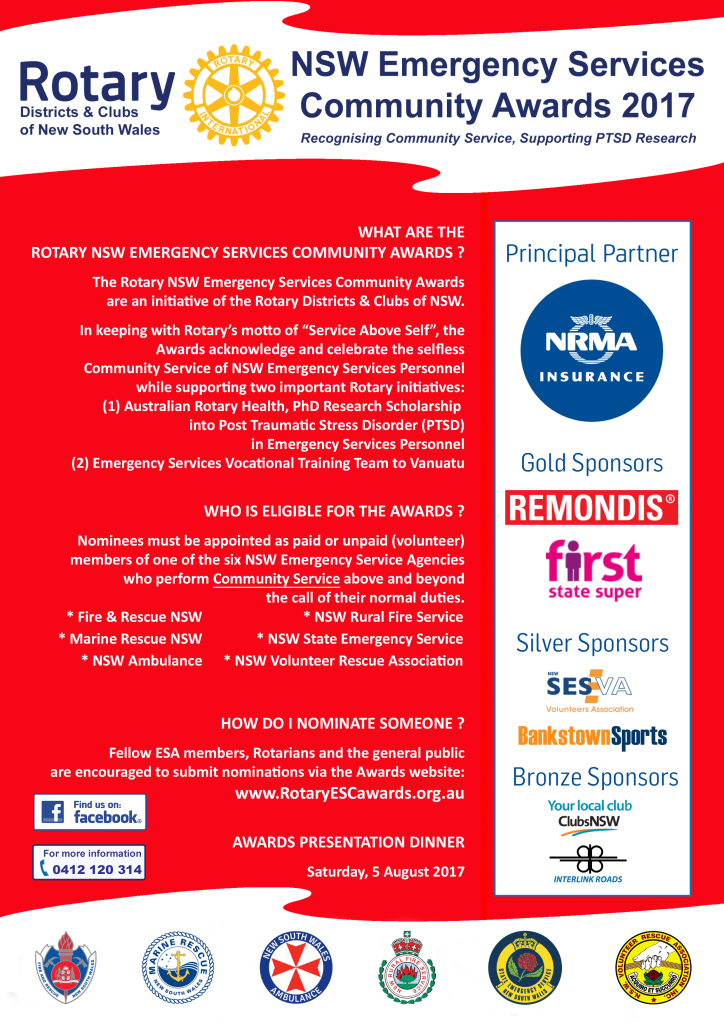
The Rotary Clubs of NSW Police Officer of the year and Emergency Services Community Awards

Our Club can nominate a police officer or emergency services officer to be considered for these awards. Just email me if you think you know someone who we should nominate.

The NSW Police Officer of the year details are in this link – rotary-2017-flyer-a5-2up

Details of the NSW Emergency Services Community Awards are in the flyer below:


From Rotary Scholar to Peace Corps

Please note the organisation KIVA that may be an avenue for our Club to achieve a positive presence for Rotary and assist individuals that we select to achieve their goals.


By Jasmine Segall, former Rotary global grant scholar

I have heard a variety of interesting stories about why the rural Costa Rican town I live in as a Peace Corps volunteer is called Monterrey. My favorite is the literal translation: “King of the Grass,” explained by a wizened elderly gentleman as the place his family settled to farm cattle because of its nutritious vegetation. On a good day, I can get a clear view of the Arenal Volcano and see the lush farmland that stretches endlessly below. The view is breathtaking. It truly is a green kingdom.

My path to becoming a “loyal subject” of Monterrey was influenced by a lifelong involvement in community service. I grew up participating in the Girl Scouts, 4-H, and Key Club. As an undergraduate at the University of California, Berkeley, I volunteered at Kiva – a nonprofit that makes small loans to empower entrepreneurs around the world.

https://www.kiva.org/

One of the highlights of my undergraduate experience was starting a student group that partnered with Kiva to offer no-interest microloans to low-income entrepreneurs in Oakland, California, USA. Our first borrower used the profits generated from her microloan to fund her son’s college education. As I am the daughter of a university professor, being able to impact someone’s life this way left a powerful impression. The experience cemented my commitment to a career in local economic development.

A Rotary global grant made possible my dream of obtaining a Master of Science in Local Economic Development at the London School of Economics. Being exposed to such a diversity of international development theories and change-makers made my time in London one of the most inspiring periods of my life. Meeting Rotarians with an incredible dedication to service at both the Berkeley Rotary Club, which sponsored my global grant, and the Sidcup Rotary Club, which hosted me in the UK, reaffirmed my commitment to dedicating my own life to service. It was actually the experience of earning a master’s degree that gave me the confidence to apply to the Peace Corps.

Jasmine Segall, center, at a rally to defend children’s rights.

I have been serving as a Peace Corps Community Economic Development volunteer for almost a year now, and my primary focus is promoting women’s empowerment and entrepreneurship. Examples of some projects I work on include helping a small women’s group plan a sewing business and partnering with Grameen Bank to offer business coaching to female microloan borrowers.

One of my best friends and co-workers here in Costa Rica is a mother of four who works as a professional clown and volunteers for the national social service organization to entertain some of the poorest children in Costa Rica. Her life story is incredible. For someone who struggles to feed her children as a single mother, her passion for helping other children both humbles and inspires me.

Rotary has left a profound impression on me, as will my time as a Peace Corps volunteer. I can only hope that the next step will be similarly rewarding.

Read the Rotary-Peace Corps partnership fact sheet for collaboration opportunities for clubs and districts. If you’re attending the 2017 Rotary Convention in Atlanta, visit the Peace Corps booth in the House of Friendship and attend a Rotary-Peace Corps breakout session to learn more about the partnership. Email rotary.service@rotary.org if you have any questions.

Rotarian Returned Peace Corps Volunteers are invited to District 5450’s Rotary-Peace Corps workshop on 4 August 2017 in Denver, Colorado, USA. Contact Charlie Hunt or Steve Werner for more information and to register for the workshop.

President’s Comment – 26 Mar 17

Hi All – some good ideas here?

Meet my vibrant club

Members of the Seoul Young Leaders Satellite Club in Seoul, Korea.

S. David Chang

By S. David Chang, Rotary Club of Seoul, Korea

Our club, The Rotary Club of Seoul, was established in 1927 as the first club in Korea. We are unique in that our members are multinational and our official language is English. Like most other clubs, our challenges were: diminishing membership; inability to attract younger people; lack of community service; and uninteresting meetings sinking motivation and enthusiasm.

In recent years, our club board decided to transform our club with several new initiatives. We decided to form a satellite club for English speaking young leaders in Seoul between age 19-35. The group got started with Ray Chetti as its first leader, and we were successful in recruiting 65 young leaders. During the first year, this “Seoul Young Leaders Satellite Club” conducted 38 fundraising and community service events, raising over $7,000. Now with new co-presidents (Sayel Cortes & Haein An), the club is focusing on helping single mothers without support.

Another exciting thing we did was to create a “convertible membership program” for busy people of age 36-55 to pay only half of our annual fee and come only a couple of times per month.

We also decided to lower the barriers for new members. We got rid of the clerk and lowered the annual dues and made our meetings more interesting. Now, every month, we have one formal lunch meeting, one community service event, one informal fellowship night, and one cultural or outside activity to engage new friends.

By cutting down operational expenses enough to give a $100 contribution to The Rotary Foundation for every member, we became the only 100% Foundation Giving Club within our district. During the first year of our transformation, we increased our membership from 38 to 125 including 65 young leaders. We wiped out almost all district awards and restored our club image and reputation. It is important to create a challenging vision with stretching goals, but it is more important to sustain that momentum for several years. We are lucky to have club leaders like Andrew Lee, Marc DeVastale, Sugar Han, and many others who really care for Rotary and our club.

Rotary is all about service and friendship; and we must continue to be creative to make it enjoyable and meaningful.

Learn more about the new club flexibility measures

President’s Comment – 12 Mar 17

Next GoToMeeTing Change of Date

Please note that I have had to change the next GoToMeeting date to Wednesday 12th April as I will be out of internet contact the week before. I hope that this does not inconvenience too many members.

When more women work, economies grow

By Annemarie Mostert, a member of the E-club of Southern Africa

On International Women’s Day, 8 March, it is important to reflect on the milestones women have achieved in economic opportunity, and the role Rotary clubs can play.

The World Economic Forum’s latest Global Gender Gap report identified the continued burden of economic inequality and gaps in economic opportunity for women across the world. This data isn’t just about representation and greater opportunity. It is important for global economic growth.

Put simply, “When more women work, economies grow.” And you may be startled by how much. A recent McKinsey report estimates that if women play an “identical role in labor markets to that of men,” this could potentially add “$28 trillion, or 26 percent” to the global GDP.

As a member of Rotary, the global nonprofit at the intersection of commerce and cause, I believe that I have to make an impact at a local level. Rotary’s model is unique because although many organisations allow you to network professionally or get involved in community projects, few allow you to combine both of these opportunities.

Twelve years ago, I started a nonprofit called Sešego Cares in South Africa, based on a model that combines socially responsible business with sustainable projects to empower vulnerable people through skills and enterprise development. We’ve educated and enabled women to start their own bakeries, gardens, sewing projects, libraries, and other small enterprises to boost their sense of self-worth, lift themselves out of poverty, learn transferable skills, and transform their communities. As our model channels the power of private sector volunteerism through mentorship and job creation, we’ve also managed to eliminate administrative costs.

One project of which I’m particularly proud is the Zandspruit Bakery in Johannesburg, which opened its doors in 2012. This is a self-sustaining micro-enterprise powered in the beginning only by a solar oven, which can cook great quantities of food to feed many, with no fuel costs. With private sector sponsorship, and help from a local Rotary club, the facility trains entrepreneurs seeking to enter the formal economy.

Eight community members participated in a Business Management training course, and now run the bakery at a profit, as the goods, including bread, scones, biscuits and doughnuts, are sold to the local community at a cost lower than other suppliers. Profits are reinvested in the community, and the solar oven is a more affordable alternative to electricity.

In South Africa, we are in the top ten (no.6) of countries where women work more minutes per day than men. This reflects global data which shows that ‘women still spend more of their time on unpaid work such as housework, childcare and care for older people.’ This means less time for women to pursue economic opportunities, fewer women in senior management positions, and limited participation in shaping social and economic policies.

All this compounds existing inequalities as women have a lack of access to important assets like financial loans, or a lack of secure access to land rights. Gender based violence is also a serious issue in the country, with ‘intimate partner violence’ accounting for up to 70% of female murder victims by some estimates.

Progress has been made in legislation for women’s equality, education and political participation, but to convert legislation into action requires local engagement with socially conscious local partnerships involving civil society, the private sector and the government.

Bold action is required to challenge the recent prediction that the gender gap won’t close entirely until 2186, which is too long to wait. As Rotarian, we have a responsibility to use our unique position to make a difference.

President’s Comment – 26 Feb 17

REMINDER OF GOTOMEETING THIS NEXT WEDNESDAY-1st March at 7.30pm EASTERN DAYLIGHT TIME

You will receive an email today with the link to the meeting. Please attend if at all possible.

I am back home again after a great skiing holiday.

Below is an interesting  post from a member of an E-Club in Western Australia that has a message for all Rotary Clubs I think.

How inclusive is your club?

Posted on by

170217_mckenzie


By Kate McKenzie, Rotary E-Club of Western Australia

Recently, I came across the concept of “conscious inclusion” when reading an article about how a bank consulted with an NGO for people with vision impairment when designing their new credit/debit cards. I started thinking about whether Rotary clubs are practicing conscious inclusion.

Unconscious bias means that we are often not aware of the needs of others. We may be willing to adjust if someone asks, but we may not be proactive about thinking ahead, asking for advice and then communicating with people that we have considered their needs.

People used to raise children in their 20s so by the time they were in their 30s they were starting to have time to do other things. Now parents often welcome their first born when they are are in their 30s and juggling career with everything else. Volunteering with Rotary could be easier if children could be a part of it. Does your venue have highchairs and maybe a small box of toys/books? Does your website mention that children are welcome? Do you plan some activities in family-friendly places like parks?

The Rotary E-Club of Western Australia

The Rotary E-Club of Western Australia

When I became a mother, I was suddenly a lot more aware of street design, building entrances and corridor width. Pushing a pram around made me aware of the challenges that people using a wheelchair must face. Has your club conducted an accessibility audit of the venue(s) where you meet? Do you consider accessibility when planning social events? Perhaps you could engage a guest speaker to help learn what you need to consider? You may find that persons with disability are more likely to join your club if your website gives them key information relevant to their needs.

In my previous Rotary club, one of our members had impaired hearing. He was taught to lip read from a young age, so didn’t use sign language. It was important, however, that we allowed him to sit where he could easily see the guest speaker and that we made an effort to face him directly during conversation. Through asking him what he needed, we learned how to make his Rotary experience more fulfilling.

Finally, many Rotary clubs come together in the act of sharing food. It’s important, however that we consider medical, ethical and religious dietary needs, so that food doesn’t divide us. Does your venue serve vegetarian or vegan options? Can kosher, halal options be made available? Do you collect information about dietary requirements in advance? If a member or visitor is fasting, can they attend without feeling obligated to pay for a meal? Is the kitchen capable of serving food that is safe for people with allergies or other medical needs?

A little forethought can go a long way to making our clubs more welcoming of diversity in our communities. Diversity makes us stronger.